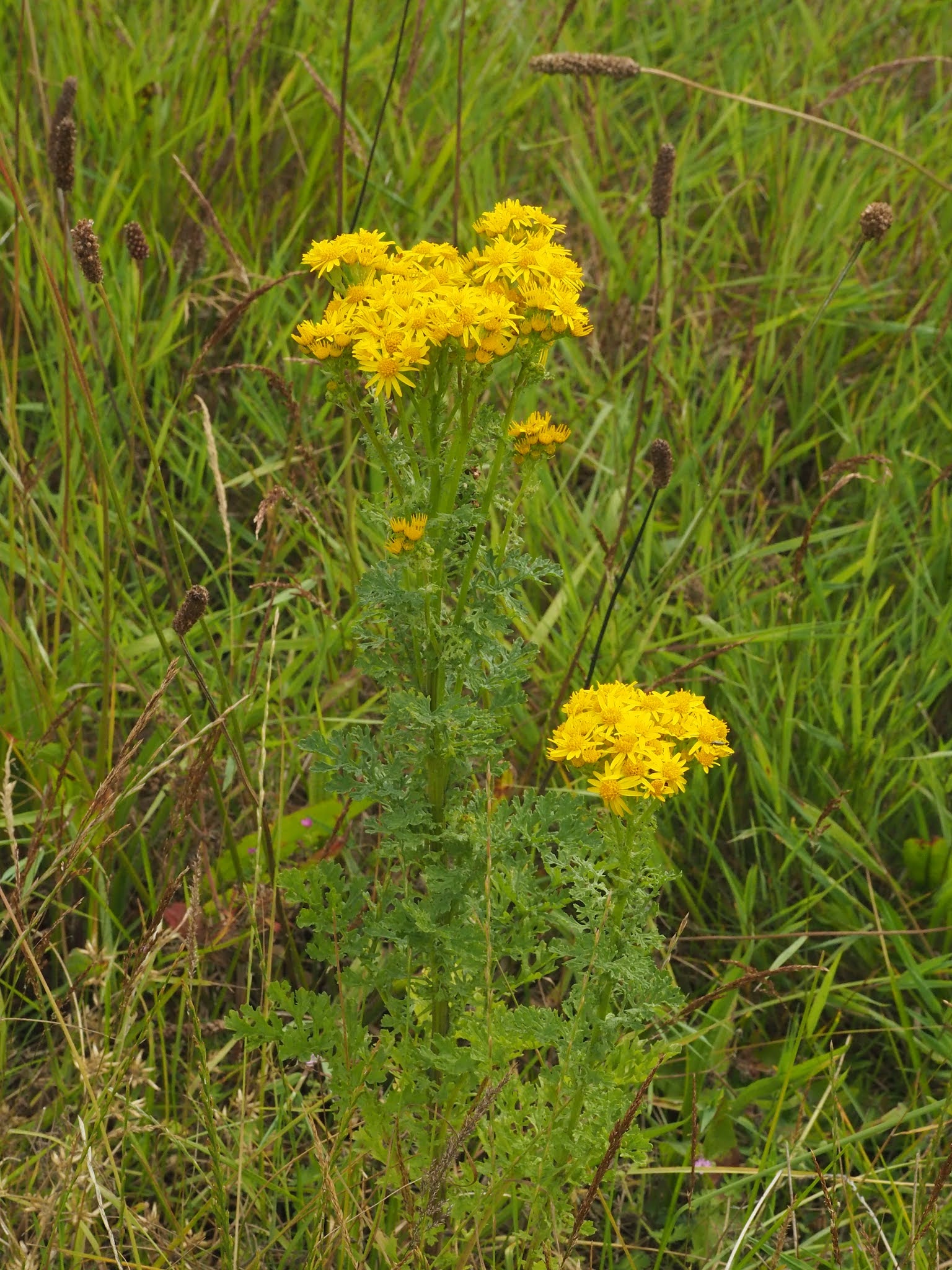
Common name: Oxford Ragwort
Scientific name: Senecio squalidus 牛津千里光
Genus: Senecio 千里光屬
Family: Asteraceae or Compositae 菊科, aster , daisy, composite or sunflower family
Origin: Neophyte (established after 1500 AD). It is a diploid hybrid derivative of S. aethnensis 千里光 and S. chrysanthemifolius 西西里雛菊 that grow at high and low altitudes, respectively, on Mount Etna 埃特納火山 in Sicily, Italy and that form a hybrid zone at intermediate altitudes. Historical records show that such hybrid material from Sicily was introduced to the Oxford Botanic Garden in Britain in the early part of the 18th century and began to spread from there after approximately 90 years[1]. It was first recorded in the wild in 1794 as an escape from Oxford Botanic Garden.
Date: 28th July

8109 A decumbent to erect, more or less glabrous annual or short-leaved perennial, can reach up to 30cm. Very variable.

8114 Stem.

8115 Leaves deeply lobed. These are lower leaves.

8117 Upper leaves.

8118 The underside of the leaf.

8120 The inflorescence.

8113 Flower buds.

8112 Involucral bracts all black-tipped.

8111 Flower heads 16-20mm; 12-15 ray florets.

8111-1 Close-up of the flower showing 5 petals of the disc florets, the anthers and the stigma.
Remarks: [1] Recent, allopatric, homoploid hybrid speciation: the origin of Senecio squalidus (Asteraceae) in the British Isles from a hybrid zone on Mount Etna, Sicily, Juliet K James and Richard J Abbott