Wednesday, 23 March 2022

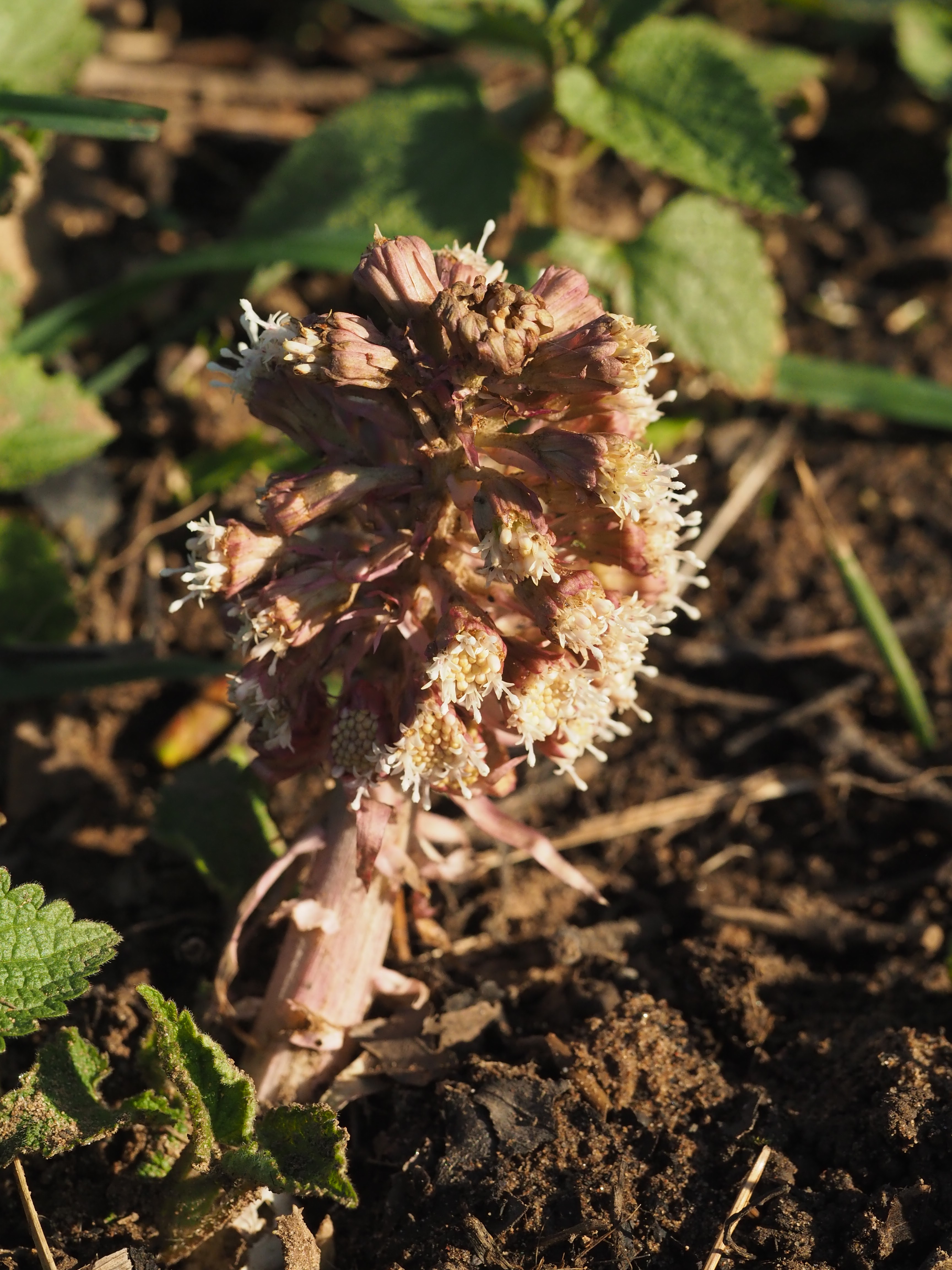
Petasites hybridus 紫蜂斗菜, 歐蜂斗菜

Common name: Butterbur
Scientific name: Petasites hybridus 紫蜂斗菜, 歐蜂斗菜
Genus:  Petasites 蜂斗菜屬
Family: Asteraceae or Compositae 菊科, aster , daisy, composite or sunflower family

Remarks:  It is a dioecious plant 雌雄異株. In Britain, the male plants are widespread, but the female plants have a restricted distribution in northern and central England. Male-only colonies are probably single clones, many perhaps from deliberate plantings for a source of pollen and nectar for hive bees. It spreads mostly vegetatively from rhizome fragments.

Its common name derives from its large, heart-shaped leaves that were used to wrap butter in the past. Its generic name Petasites is derived from the Greek petasos, meaning a 'broad-brimmed felt hat' which also refers to the enormous leaves.

Origin: native

Date:  18th March & (18th April)

a riverside colony

a few leaves already appear

a flowering stalk and a leaf on its left hand side

photos above and belows: flower bud in different stages


rhizome and the roots

leaf is emerging on the left


flowering stalk


flower buds


A male flower, the bulb-like structure protuding in the centre of the flower is actually the pollen presenter instead of stigma.


leaf will soon be unfolded

newly unfolded leaf


withering flowering stalk

--------------------------------------------------------------------------------------
The following photos were taken on another location on 18th April.

169

170

184

175

174

182

Sunday, 20 March 2022

Petasites japonicus 蜂斗菜

Common name: Giant butterbur
Scientific name: Petasites japonicus 蜂斗菜
Genus:  Petasites 蜂斗菜屬
Family: Asteraceae or Compositae 菊科, aster , daisy, composite or sunflower family

Remarks: It is native to China, Japan, Korea and Sakhalin 庫頁島. It is planted as a garden plant in 1897 and is first recorded in the wild in 1924. It is a dioecious plant. The photo taken below are male plants.

Origin: Neophyte* (established after 1500 AD). (*It is an introduced species)

Date:  17th March


a smaller plant with flowers

A larger plant. Those green leaf-like structure are not leaves indeed, they are bracts. The whole structure above the ground is the flowering stalk. Flowers appear first and leaves appear at a later stage.

The real leaves appear later.


Leaves already appear while the flowers are still persisting at this stage.

All are male flowers.

anther (yellow) and the protuding pollen presenter


pollen presenter

Sunday, 13 March 2022

Tussilago farfara 款冬

Common name: Colt's-foot
Scientific name: Tussilago farfara 款冬
Genus: Tussilago 款冬屬
Family: Asteraceae or Compositae 菊科, aster , daisy, composite or sunflower family

Origin: Native

Remarks: The common name of colt's-foot comes from the hoof shaped leaves. The leaves resemble the foot of  a horse. The generic name Tussilago means ‘cough dispeller’. It comes from the Latin "tussis", meaning cough. The plant was recognised by early herbalists as being good for the lungs. The dried leaves were formerly smoked as a remedy for asthma and coughs.

Date:  9th & 17th March

something emerging from the ground.....


flower bud


sepals with muddy-green central stripe

There are ray florets as well as disc florets

There are no leaves at this stage.

-------------------------------------------------------------------
Photos belows were taken on 17th March at different location:

leaves appear 


disc florets at the centre and ray florets on the periphery

Saturday, 12 March 2022

Chrysosplenium oppositifolium

Common name: Opposite-leaved Golden Saxifrage
Scientific name: Chrysosplenium oppositifolium
Genus: Chrysosplenium 貓眼草屬, 貓兒眼睛草屬, 金腰屬
Family: Saxifragaceae 虎耳草科, saxifrage family

Origin: Native

Date:  9th March 


Baby plants and you could see the basal leaves are not cordate.

petiole as long as or shorter than blade

Stem is square in cross-section.

Leaf stalks are broad and flat as they approach the main stem.

flower buds


4 sepals, no petals, 8 stamens and 2 styles