Sunday, 8 May 2022

Valerianella carinata

Common name: Keeled Cornsalad
Scientific name: Valerianella carinata
Genus: Valerianella 新纈草屬*
Family: Caprifoliaceae 忍冬科, honeysuckle family

Remarks*:It is formerly placed in Valerianaceae 敗醬科, valerian family. The family is now catergorized as subfamily Valerianoideae 纈草亞科 of  Caprifoliaceae 忍冬科, honeysuckle family by APGIV.

Origin: Archaeophyte (established before 1500 AD.) It has a European Southern-temperate distribution.

Date: 18th, 22th, 25th April (& 4th June)


A small roadside plant. Flower in terminal open inflorescence.


Another smaller plant.


Leaves simple.


There are hairs on the leaf margin. Margin sparsely toothed. Note the stem is square in cross-section.

Leaves at the base of the plant.

Photo enlarged below to see the details of the flowers.


Flower bud. (in the middle of the photo)


Side view of an individual flower. 5 petals.

Side view of the inflorescence showing the bracts.


5 petals, 3 stamens and 1 style.

Another photo enlarged below.


There are 5 petals, 3 stamens and 1 style for each flower.


The bracts and the inflorescence. Enlarged below to see the details of the flowers.


Side view of the flower. Note there are 3 stigmas for each style. 


Another flower enlarged below.


Fresh anthers are pink.

Fruit appears now in the fork of the branch. Note the shape of the ripe fruits are the only way to distinguish the five Valerianella spp in UK.
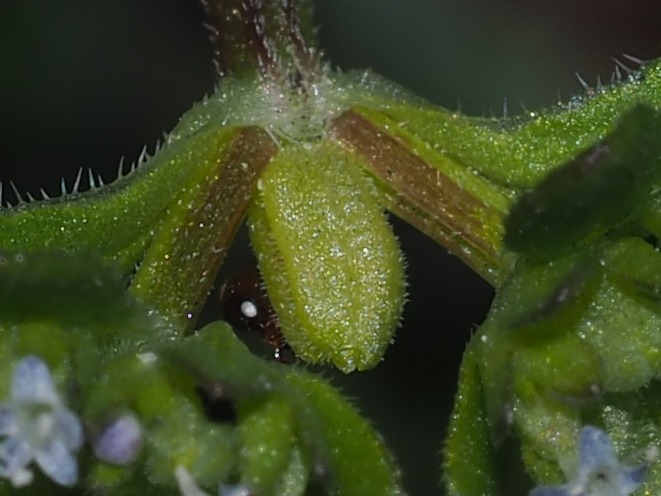

This is a developing fruit, not a ripe one. But you could see that the length of the nut is nearly twice that of its width, and there is a groove on one side (the left side of the above photo.) (vs the nut is nearly spherical in Valerianella locusta 高苣纈草, 野苣, 羊萵苣, common cornsalad.)

Another specimen, enlarged below to see the shape of the fruit.


The length of the nut is nearly twice that of its width, and there is a groove on one side (the right side of the above photo.)

One more specimen enlarged below to see the fruit.


Another one.


The shape of this fruit looks a bit different from the other specimens. Maybe the nut is still developing. Groove could be seen in this nut.

Another angle of the same inflorescence and fruit.


The groove could be clearly seen on it. (the bottom side of this photo)

63

64

65

67

Tuesday, 3 May 2022

Veronica filiformis

Common name: Slender Speedwell
Scientific name: Veronica filiformis
Genus: Veronica 婆婆納屬*
Family: Plantaginaceae 車前科, plantain family

Remarks*: Veronica was formerly classified in the family Scrophulariaceae 玄參科, figwort family.

Origin: Neophyte (established after 1500 AD). It is a native of N. Turkey and the Caucasus. It was cultivated by 1808 and was first recorded in the wild in 1838 but not reported again until 1927.

Date: 19th April


A pubescent perennial, can reach up to 50 cm. Photo enlarged below to see different shapes of the leaves.


Leaves about 5 mm, orbicular to kidney-shaped.


Leaves bluntly, regularly toothed. (vs leaves with 5-7 large teeth or small lobes in Veronica hederifolia 睫毛婆婆納, Ivy-leaved Speedwell)

Photo of another plant. Enlarged below to see the different shapes of the leaves.


Leaves at the top.


Leaves orbicular to kidney-shaped.

Leaves with short stalks. Photo enlarged below.

 Underside of the leaf.

Flowers solitary in axils of leaves. Pedicels are slender and much longer than leaves.

Photo enlarged below to see clearly the flower buds.


Flower bud.

Photo enlarged below to see clearly the sepals.


Side view of the flower to see the sepals.

Photo enlarged below to see the details of the flower.


Corolla 8-15 mm, purplish blue. 4 petals, the lower one is smaller but longer. 2 stamens and 1 style.

Veronica montana

Common name: Wood Speedwell
Scientific name: Veronica montana
Genus: Veronica 婆婆納屬*
Family: Plantaginaceae 車前科, plantain family

Remarks*: Veronica was formerly classified in the family Scrophulariaceae 玄參科, figwort family.

Origin: native

Date: 25th April


Found in damp woodland.

Another plant.

Leaves distinctly stalked. Photo enlarged below to see the hairs on the stem.


Stem hairy (glandular hairs) all round.

Leaves serrately toothed.

Raceme in axil.

Photo enlarged below to see the flower buds.

Flower buds.

Raceme. Photo enlarged below.


Bracts (the green leaf-like structure at the base of the flower stalk) much shorter than pedicels.


Sepals of the flower. Photo further enlarged below.


Glandular hairs on the under side of the sepals and flower stalk.


Glandular hairs all round the stem.

Raceme 2 to 5 flowered. Photo enlarged below to see the details of the flower.


Corolla about 7 mm across, lilac-blue.

Another flower, enlarged below.


4 Petals, the lower one is smaller. 2 stamens and 1 style.

Veronica serpyllifolia subsp. serpyllifolia 小婆婆納

Common name:  Thyme-leaved Speedwell
Scientific name: Veronica serpyllifolia subsp. serpyllifolia 小婆婆納
Genus: Veronica 婆婆納屬*
Family: Plantaginaceae 車前草科, 車前科, plantain family

Remarks*:Veronica was formerly classified in the family Scrophulariaceae 玄參科, figwort family.

Origin: native

Date: 26th April

A creeping perennial, can reach up to 30 cm. Flowering stem ascending. 

Flowers in terminal raceme.


Photo enlarged below to see the leaves.


Leaves 1-2 cm, glabrous, more or less entire. 

Photo enlarged below to see the flower buds.


The flower buds. The bract (the green leaf-like structure below the flower stalk) is longer than the pedicel.

Flowers in terminal raceme. Photo enlarged below.


2 stamens and 1 style.


Lateral view to see the sepals.

Photo enlarged below.


Corolla white or pale blue, 5-10 mm. (vs Corolla bright blue, 7-10 mm in Veronica serpyllifolia subsp. humifusa.)  There are 4 petals, the lower one is smaller. 2 stamens and 1 style.


The lower part of the plant is fruting. Bract is longer than the pedicel.