Common name: Hogweed
Scientific name: Heracleum sphondylium 歐獨活, 豬草, 普通豬草, 牛防風, 牛歐洲防風草
Genus: Heracleum 獨活屬, 白芷屬
Family: Apiaceae or Umbelliferae 傘形科, 繖形科, celery, carrot or parsley family
Remarks*:
Origin: native
Date: 27th May

Distinctive leaf sheath at the base of the compound leaves.

A leaf sheath that clamps the stem. A undeveloped flowering shoot is found inside it and will protrude on later season.

The leaf sheath.

This plant has the flowering shoot prolonged a little bit.

Inflorescence could be seen in these plants.

Another plant showing the leaf sheath.

Different stages of the leaf sheath and the petiole inside them.


There are ridges and grooves on the downy stem. There may or may not have purple hue on the stem. (vs no ridges and grooves on the stem with sharp bristles. There are distinctive purple blotches on the stem in Heracleum mantegazzianum 大葉牛防風, 大豕草, giant hogweed.)

The downy hairs on the stem. No purple blotches at the base of the hairs. (vs sharp bristles on Heracleum mantegazzianum 大葉牛防風, 大豕草, giant hogweed.)

The petiole, enlarged below to show the hairs.

There are two kinds of hairs of different tallness.

Leaf simply pinnate. Leaflets are lobed and coarsely toothed. The lower leaflets are stalked. (see the top middle part of the above photo.) (vs the leaves are pinnate to ternate, very deeply divided, angular and pointed in Heracleum mantegazzianum 大葉牛防風, 大豕草, giant hogweed.)

Side view of the leaf.

The underside of the leaf, enlarged below to show the hairs.

Hairs on the underside of the leaf.

A tall, robust, pubescent biennial, can reach up to 2 m. Flowering shoots appear at the axil of the leaves as well as at the top of the plant.

The flower heads are flat-topped, curved or like a pom-pom. (vs umbrella-shaped or dome-shaped in Heracleum mantegazzianum 大葉牛防風, 大豕草, giant hogweed.)

The flower head (compound umbel 複傘形花序) at the top of the plant. The compound umbel is around 20 cm across. (vs around 50 cm across in Heracleum mantegazzianum 大葉牛防風, 大豕草, giant hogweed.)

There are 8-15 rays (primary rays) of the umbel. (vs more than 50 rays of the umbel in Heracleum mantegazzianum 大葉牛防風, 大豕草, giant hogweed.)

Bracts are absent (quickly withering?) or few. (absent on the above photo.)

Underside of the secondary umbel (umbellet, umbellule 小傘形花序, 次生傘形花序), enlarged below to see the bracteoles . (1st June)

Several reflexed bracteoles at the base of the secondary umbel (umbellet, umbellule). There are 20 secondary rays (pedicels) that hold individual flowers.

The underside of an individual flower, enlarged below to see the details.

Green and hairy calyx.
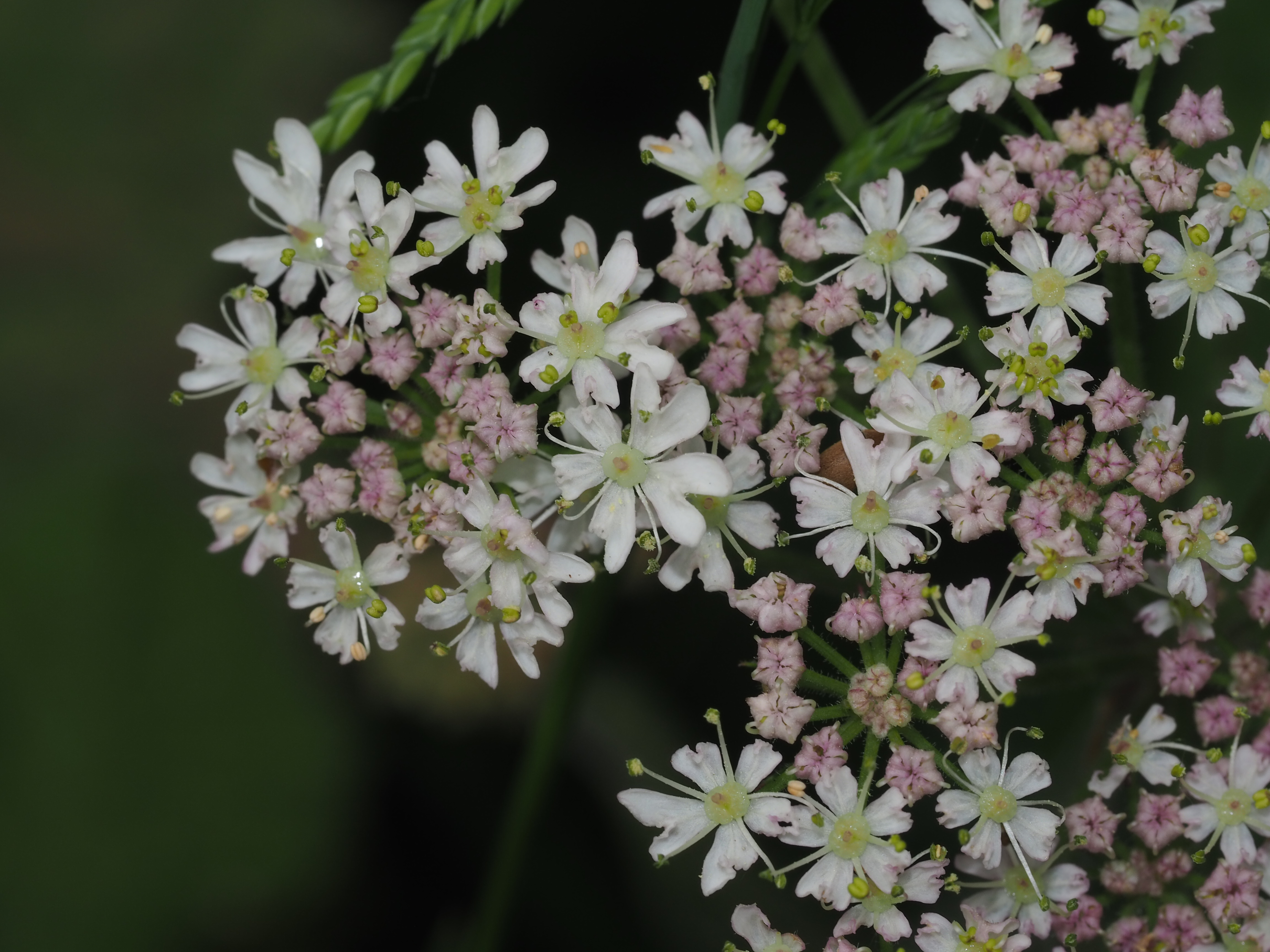
Photo enlarged below to see the different stages of the flowers.

Those inner flowers of the umbellule are more regular (5 petals are equal in length). 5 stamens are yet to unfold.

This flower is more irregular (zygomorphic). (petals are of different length)

Another photo enlarged below to see the different stages of the flower buds.

These flower buds are ready to bloom.

5 petals, deeply notched.


This outer flower is irregular. 5 petals, 5 stamens and 2 styles. (The 2 styles on the above photo seems to be fused together.)

Another photo, enlarged below to see the details.

2 separated styles could be seen in this flower.

Another photo, enlarged below to see the side view of the flower.

Side view of an individual flower.

Ridged, oval-shpaed fruits (schizocarps).

Developing fruits, 7-8 mm.

Photo taken on 3rd July at another location.

There are 4 oil ducts (dark stripes) appear on the later stage of the fruits.