Friday, 16 May 2025

Primula vulgaris 歐報春、歐洲報春花、西洋櫻草

Common name: Primose
Scientific name: Primula vulgaris 歐報春、歐洲報春花、西洋櫻草
Genus: Primula 報春花屬
Family: Primulaceae 報春花科, primrose family

Origin: native 

Remarks: It is specially protected by law in Northern Ireland.

Date: 6th April

[170] Perennial. A cluster of thrum-form plants.

[158] Thrum-form plant.

[157] Pin-form plant.

[165] Leaves 8-15 cm, in a basal rosette, sparsely hairy above (could not be seen in the above photo).

[166] Underside of the leaf.

[167_1] Leaves pubescent below, tapering gradually to base.

[164] Flowers arising singly from base of plant. But the photo above showing an inflorescence with different stages of flowers. Maybe it is not Primula vulgaris but a hybrid. Its identity needed to be confirmed later.*

[*According to Biological Flora of the British Isles: Primula vulgaris Huds. (P. acaulis (L.) Hill), plants occur occasionally with the umbels on a scape up to 10 cm high and shorter pedicels than normal (var. caulescens W.D.J. Koch).]

[164_1] Flower buds.

[164_2] Buds start blooming.

[160_1] Side-view of the flowers showing the white petals and the green sepals, stalks about 10 cm long, with shaggy hairs.

[162] Flower about 3 cm across. This is a pin-form flower, see the enlarged photo below:

[162_1] Pin-form flower, the stigma is higher than the anthers (It could be seen above)

-------------------------------------------------------------

[163] Thrum-form flower, see the enlarged photo below:

[163_1] Thrum-form flower, 5 anthers are protruding from the flower, with stigma hidden down below (could not be seen in above photo).

Thursday, 15 May 2025

Primula farinosa 粉報春

Common name: Bird's-eye Primose
Scientific name: Primula farinosa 粉報春
Genus: Primula 報春花屬
Family: Primulaceae 報春花科, primrose family

Origin: native 

Remarks: It is listed as VU (vulnerable) 易危 according to IUCN Red List Categories.

Date: 11th May

[231] Perennial.

[217] A cluster of plants.

[223] Leaves 1-5 cm, in a basal rosette.

[223_1] Leaves edges crinkly 皺巴巴的.


[223_2] Leaves underside mealy 粉狀的 white.

[221_1] Flower buds.

[222_1] Flower buds start opening.

[220] Scape 花葶 to 15 cm, mealy.


[225_1] Side-view of the flower showing the pink petals. deep purple sepals, green bracts, pedicel and the scape. The sepals, pedicels, bracts and scape are all mealy white.

[219] Flowers about 1 cm across; 5 pink petals 

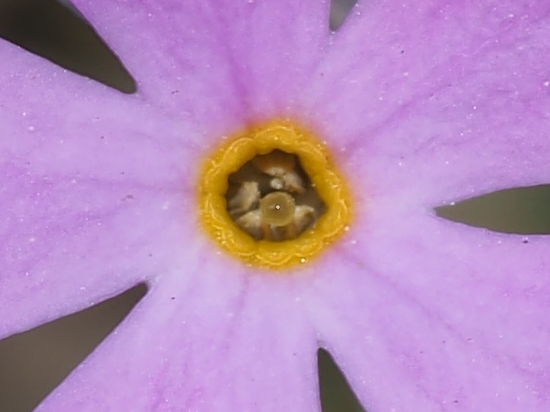
[219_1] The pin form flower. The stigma is higher than the 5 anthers.

[219_2] It is clearly seen that the stigma is protruding from the flower while the anthers are hidden inside the flower.

Wednesday, 7 May 2025

Hippuris vulgaris 杉葉藻

Common name: Mare's-tail
Scientific name: Hippuris vulgaris 杉葉藻
Genus: Hippuris 杉葉藻屬*
Family: Plantaginaceae 車前科, plantain family

Remarks*: Hippuris was previously the sole genus of the family Hippuridaceae 杉葉藻科. Following genetic research by the Angiosperm Phylogeny Group, it has now been transferred to the family Plantaginaceae, with Hippuridaceae being reduced to a synonym of Plantaginaceae.

Origin: native

Date: 5th May

[032] Rhizomatous, submerged or emergent aquatic perennial to 100cm. Found in shallow, usually calcium-rich lakes, ponds, slow-moving streams or dykes.

[027] Emergent stem stiff and erect.

[028] There are submerged and emergent stem.

[029] Leaves of submerged shoots longer, more flaccid.

[003]

[004] The horizontal rhizome.

[025] Emergent stem is about 15-30 cm above water surface.

[021] Leaves linear, sessile and entire.

[020] Leaves 6-12 in a whorl.

[014_1] Bisexual flowers are borne singly in the leaf axils. Perianth absent; 1stamen (red structure above) and 1 pointed style (white structure above).

[016_1] At the lower part of the emergent stem, flowers with 1 style and ovary could be seen.

Friday, 4 April 2025

Rubus spectabilis 鮭莓、美洲大樹莓、美莓

Common name: Salmonberry
Scientific name: Rubus spectabilis 鮭莓、美洲大樹莓、美莓
Genus: Genus: Rubus 懸鉤子屬
Family: Rosaceae 薔薇科, rose family

Origin: Neophyte (established after 1500 AD). It is a native of western North America. It was introduced in Britain in 1827 and was known from the wild by at least 1874. 

Note: This plant is listed on Schedule 9 of the UK Wildlife & Countryside Act as an invasive non-native species. Although not banned from sale, it is an offence to plant or cause these to grow in the wild in NORTHERN IRELAND and the REPUBLIC OF IRELAND. Gardeners possessing them should undertake measures to control them.

Date: 24th March


[223] Deciduous, vigorous, suckering shrub. Flowers are usually solitary on lateral branches.

[225] Can reach up to 1-4m tall.

[209] Spines on stem.

[209cropped] Weak spines (straight prickles) occurring lower down the stem.

[204] Buds.

[204cropped] Leaves developing.

[203]

[216cropped] Flowering bud (left) and leaves developing.

[221cropped] Bases of leaves showing the stipules.

[202] 7-22cm long green trifoliate (ternate), toothed leaf. Leaflets are rhomboid. Terminal leaflet is larger than the two side leaflets.

[218] Underside of the leaves.

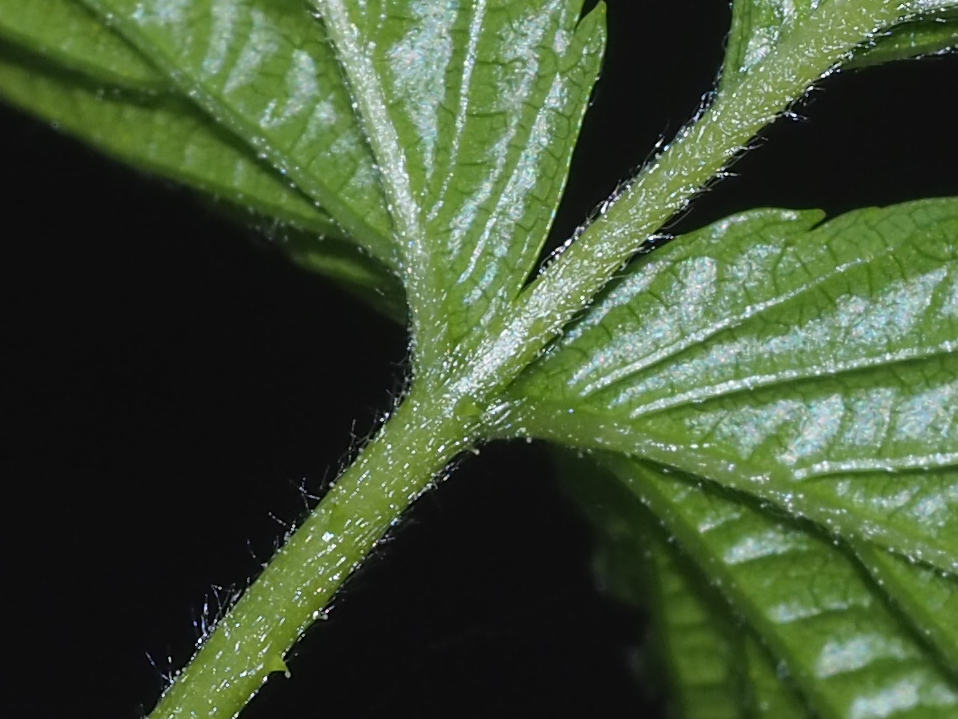
[218cropped] Hairs on the petiole as well as the mid-veins of the underside of the leaflets.

[208cropped] Flower bud.

[201cropped] Underside of the flower showing the 5 sepals.

[230cropped] Side view of a flower showing the sepals and petals.

[230cropped2] Enlarged photo showing the hairy sepals.

[211cropped1] Flower 2-3cm in diameter, with 5 pinkish-purple petals.

[211cropped2] Numerous (75-100) stamens, but pistils are still covered by the stamens for this flower.

[228cropped1] Lateral stage of a flower, both stamens and pistils could be clearly seen.

[228cropped2] Numerous stamens and pistils could be seen. Pistils with carpels above the petals could be seen above.