
Common name: Common Broomrape
Scientific name: Orobanche minor 小列當
Genus: Orobanche 列當屬
Family: Orobanchaceae 列當科, broomrape family
Remarks*: It is a root parasite on a wide range of hosts, but mainly on species of Fabaceae and Asteraceae.
Accoring to the Botanical Society of Britain and Ireland (BSBI), the current taxonomy in Britain and Ireland of Orobanche minor includes one subspecies, subsp. maritima (Carrot Broomrape), and three varieties, var. minor, var. flava and var. compositarum (Rumsey & Jury 1991; Rumsey 2007). O. minor var. compositarum has an incoherent distribution and intergrades with more nominate morphotypes, and may therefore be conspecific with O. minor var. minor. Their differences are as follows:>> O. minor var. minor produces lax, purplish spikes of cream-coloured flowers with evenly curved corollas, and bracts equalling or exceeding the flowers. The stigma lobes are distant and pinkish.
>> O. minor subsp. maritima can be distinguished from the previous variety by the pronounced yellowish bosses on the lower corolla lip, which has a larger middle lobe than the peripheral lobes. The bracts and calyx lobes of this subspecies are short and rarely exceed the corolla, and the purple stigma lobes are partially united.
>> O. minor var. flava produces short, dense spikes which are sub-globose at the apex. The entire plant is yellowish, and devoid of purple pigmentation.
>> O. minor var. compositarum is very similar to O. minor var. minor but the smaller, slender corolla tube is sub-erect at anthesis (rather than horizontal) and the filaments are sub-pillose at the base rather than sparsely hairy.


188_1 Bract (B) and the Calyx (C). Bract (B) is shorter than or as long as corolla (it is obvious shorter than the corolla in the above photo for this specimen). The calyx is composed of 2 pairs of bifid sepals with long linear lobes (calyx teeth). Not all 4 calyx teeth long and filiform (widespread).

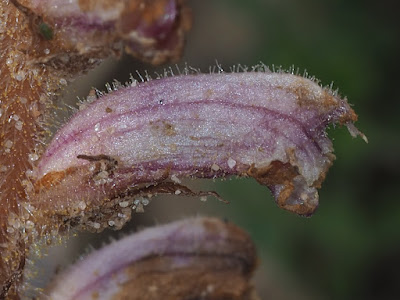
164_1 Lateral view of a flower. Flower yellowish (probably belonged to another variety), tinged purple, corolla 10-16mm.

157_1 Front view of the flower. It is a bit withered so the shape of the edge of the corolla or lip could not be seen clearly. Note the glandular hairs on the corolla tube.

161_1 Viewing form an lower anger reviewing the red stigma.

162_1 The central style (purple) and the terminal stigma (red) inside the flower.


178_1 The central style (purple) and the terminal stigma (red) inside the flower.


 \
\

177_1 Bottom view of another flower with part of the corolla tube is eaten, reviewing: (Sm) Stigma (red) and (Sy) Style (purple).


151_1 Enlarged a flower reviewing the The calyx is composed of the right bifid sepals with 2 long linear lobes (calyx teeth).
Origin: Native in Britain and the Channel Islands and a neophyte (established after 1500 AD) in Ireland.
Date: 28th July

150 Found in coastal sand dunes.

155 They are found near their host, Eryngium maritimum 濱海刺芹、海冬青, sea holly (belonged to the Apiaceae or Umbelliferae 傘形科, 繖形科).
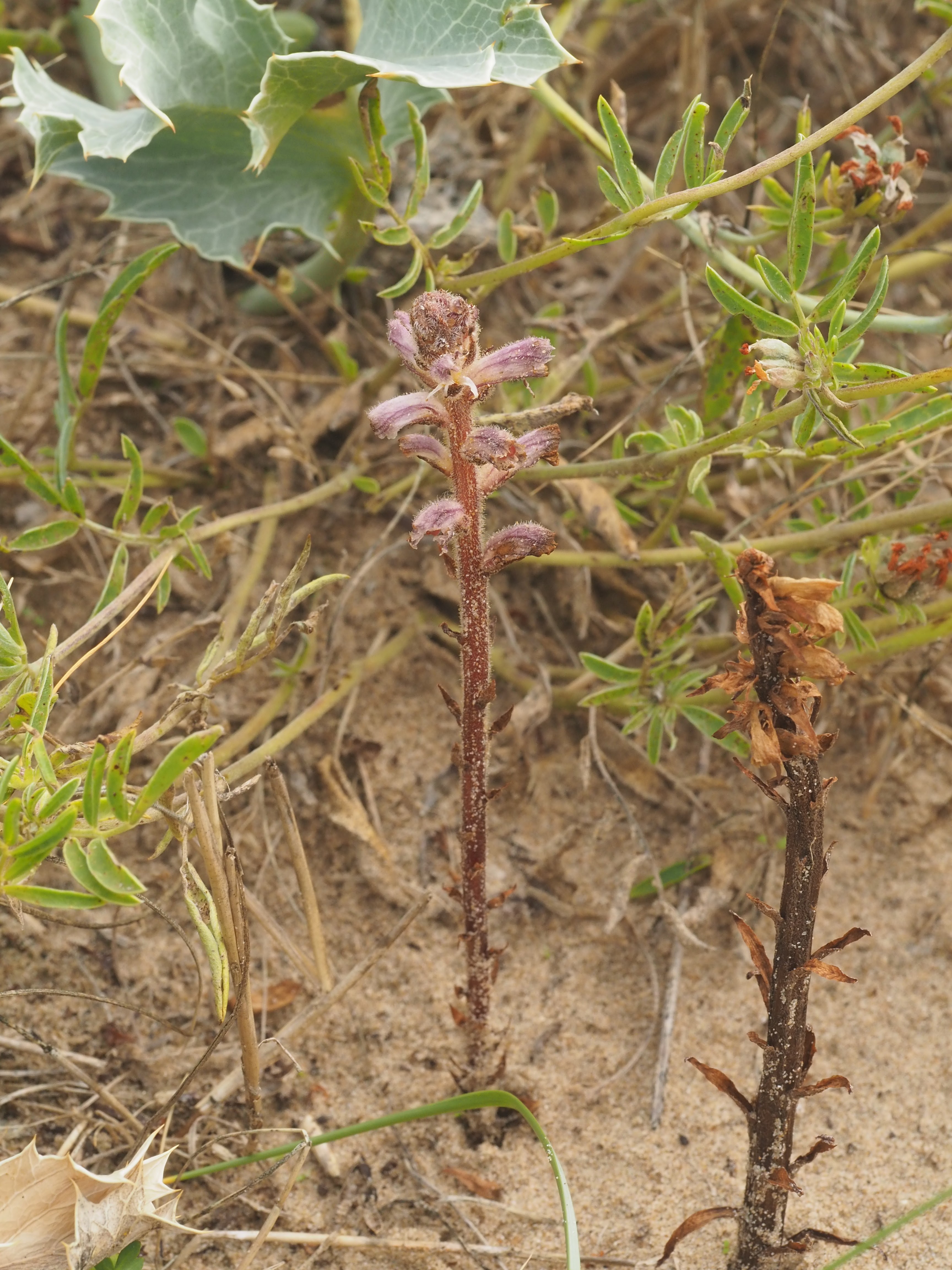
184 A still fresh plant. Spike at least half the height of the plant.

186 Stem with brown alternate scale leaves. It is said that the flowering stem is yellowish tinged with red (probably when it is young or it is belonged to another variety), can reach up to 60cm.

172 Top view of the inflorescence.

164 Later view of the flower (see the right middle one).

157 Front view of the flower (middle one).

178 The edge of the corolla tube is withered, but reviewing the red stigma,

188_2 Glandular trichomes on the stem.

188_1 Bract (B) and the Calyx (C). Bract (B) is shorter than or as long as corolla (it is obvious shorter than the corolla in the above photo for this specimen). The calyx is composed of 2 pairs of bifid sepals with long linear lobes (calyx teeth). Not all 4 calyx teeth long and filiform (widespread).

187_1 Bottom view of a flower with lower lip eaten by some animals, reviewing parts of the inner structure. (A) stamen; (B) bract; (S) stigma.
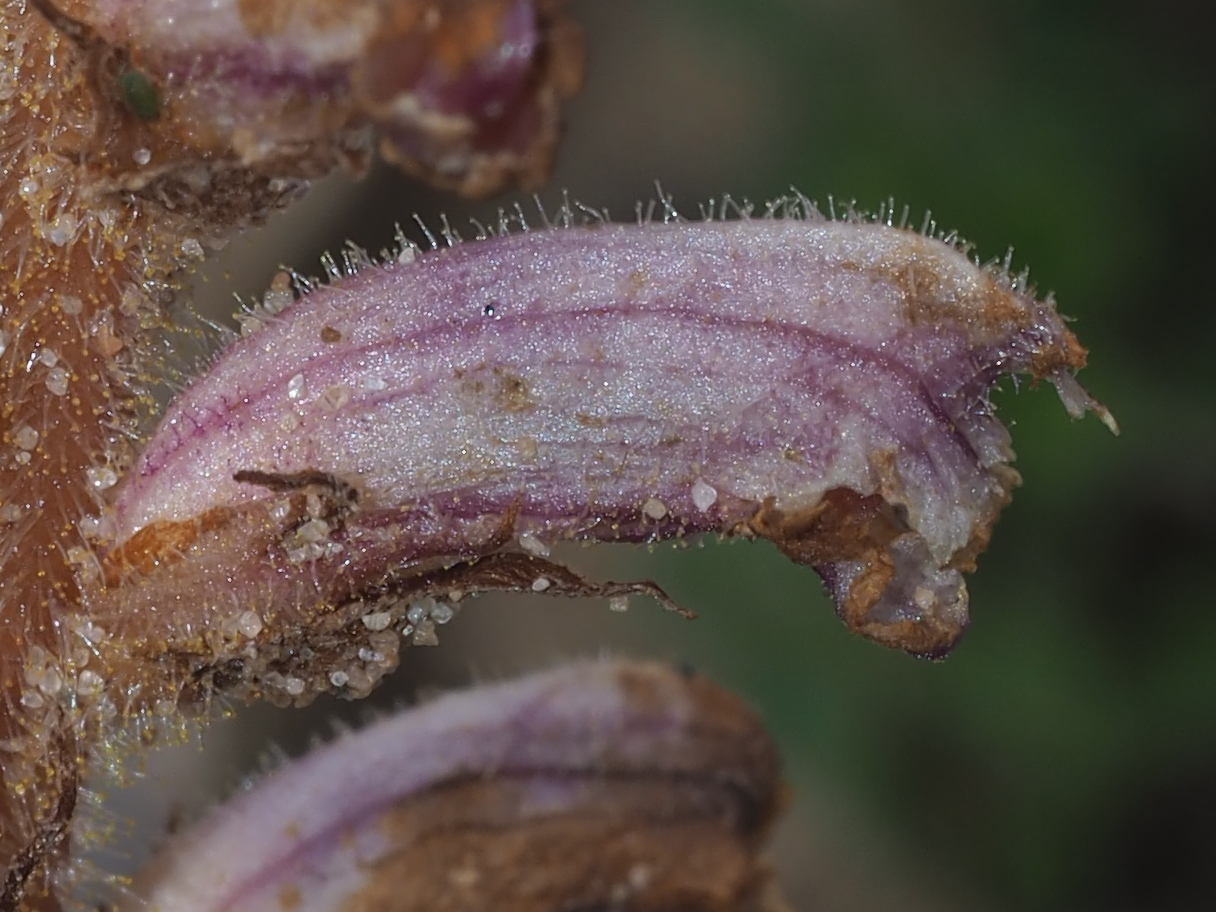
164_1 Lateral view of a flower. Flower yellowish (probably belonged to another variety), tinged purple, corolla 10-16mm.

157_1 Front view of the flower. It is a bit withered so the shape of the edge of the corolla or lip could not be seen clearly. Note the glandular hairs on the corolla tube.

161_1 Viewing form an lower anger reviewing the red stigma.

162_1 The central style (purple) and the terminal stigma (red) inside the flower.

174_1 The central style (purple) and the terminal stigma (red) inside the flower.

178_1 The central style (purple) and the terminal stigma (red) inside the flower.

175 The above plant have some of the flowers partly eaten by some animals, thus reviewing parts of the structures inside the flowers. See the enlarged and annotated photos below for details.

176

177

176_1 Lateral view of a flower with left hand side of the corolla tube is eaten, reviewing: (A) anther; (B) bract; Ca (corolla tube); Cx (calyx); (F) filament and (S) stigma.
 \
\175_1 Bottom view of a flower with bottome part of the corolla tube is eaten, reviewing: (A) anther; C (calyx); (F) filament and (S) stigma.

177_1 Bottom view of another flower with part of the corolla tube is eaten, reviewing: (Sm) Stigma (red) and (Sy) Style (purple).

149 A withered plant after anthesis.
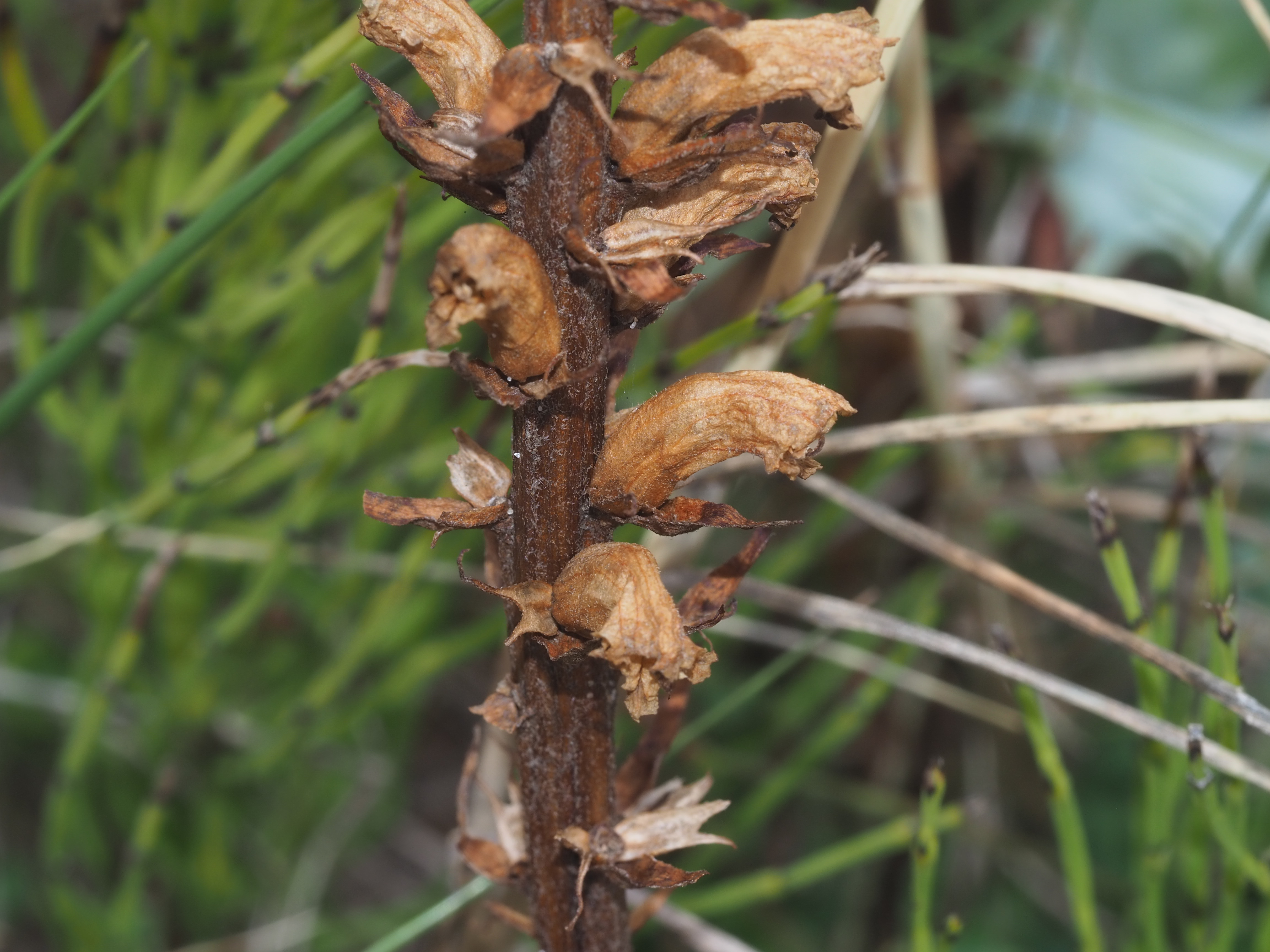
151 Maybe it is fruiting but the fruits could not be seen at this stage now.

151_1 Enlarged a flower reviewing the The calyx is composed of the right bifid sepals with 2 long linear lobes (calyx teeth).


