Showing posts with label Coccinellidae 瓢蟲科. Show all posts

Monday, 22 April 2024

Propylea quattuordecimpunctata 方斑瓢蟲

Common name: Fourteen-spot Ladybird
Scientific name: Propylea quattuordecimpunctata 方斑瓢蟲
Genus: Propylea 龜紋瓢蟲
Family: Coccinellidae 瓢蟲科, ladybirds
Suborder: Polyphaga 多食亞目, non-water beetles and weevils 象甲, 象鼻蟲
Order: Coleoptera 鞘翅目, beetles

Remarks: The 14-spot ladybird is bright yellow with up to 14 rectangular black spots on the wing cases; these spots are variable in shape and may become fused to create a chequered 方格的 pattern. It can be distinguished from the smaller, but similar, Psyllobora vigintiduopunctata 廿二點瓢蟲, 22-spot ladybird by its more rectangular, merging spots.

Adults and larvae feed on soft-bodied insects, typically aphids and whiteflies but also mites, caterpillars and insect eggs etc. They occur on a very wide range of broadleaf trees, shrubs and herbaceous plants generally, in fact anywhere that can provide a sufficient prey population. Adults can also feed on pollen and nectar and may be found on a variety of flowers, perhaps more particularly umbels, in warm weather. It has a long hibernation period, emerging as late as May to breed.

Status: Widespread. This is the only species of the genus to occur in the U.K. It is common or abundant throughout England and Wales north to the Scottish borders and including all the islands. In Scotland there are records scattered north to Inverness including a few from the Western Isles. There are records scattered throughout Ireland. The species occurs from lowlands to subalpine regions in a wide range of habitats; forests, arable land, parks, gardens and wasteland etc.
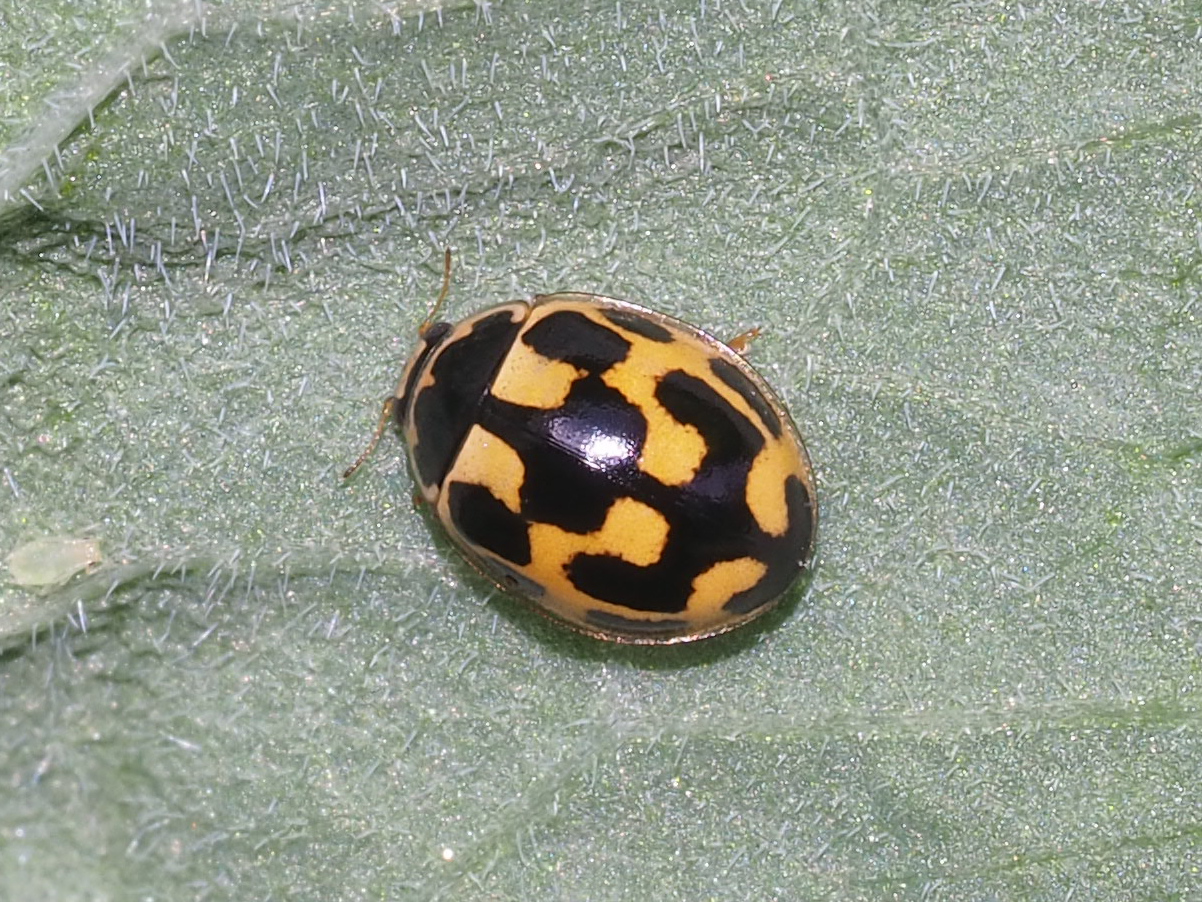
Date:  13th April


(40) 14 rectangular spots fused together to create a chequered pattern.


Tuesday, 16 April 2024

Chilocorus bipunctata 二星瓢蟲

Common name: Two-spot Ladybird
Scientific name: Adalia bipunctata 二星瓢蟲
Genus: Adalia 大麗瓢蟲
Family: Coccinellidae 瓢蟲科, ladybirds
Suborder: Polyphaga 多食亞目, non-water beetles and weevils 象甲, 象鼻蟲
Order: Coleoptera 鞘翅目, beetles

Remarks: Both adult and larvae 2-spot are voracious aphidophages and the adults are very fecund, hence their suitability as biocontrol agents on a wide range of crops worldwide e.g. cotton, peach, potato, beans etc.

Status:  It remains locally common through Europe including the U.K. but nonetheless the decline has been drastic in many areas. This decline may be due to competition with the invasive Asian Harmonia axyridis 異色瓢蟲, Harlequin Ladybird, a species known to predate the 2-spot and which has increased alongside the decline of that species. 

Date:  13th April


358_1 2 spots on  on elytra; black legs.

Sunday, 14 April 2024

Chilocorus renipustulatus

Common name: Kidney-spot Ladybird
Scientific name: Chilocorus renipustulatus
Genus: Chilocorus 瓢蟲
Family: Coccinellidae 瓢蟲科, ladybirds
Suborder: Polyphaga 多食亞目, non-water beetles and weevils 象甲, 象鼻蟲
Order: Coleoptera 鞘翅目, beetles

Remarks: Both adults are larvae predate a wide range of scale insects on various trees including Oaks, Beech, birches, willows, Alder, maples and various conifers but especially Ash (Fraxinus excelsior L.) and Mountain Ash (Sorbus aucuparia L.).

Status:  In the UK it is locally common throughout England and Wales, there are a few scattered records from Scotland but it is so far absent from Ireland. Typical habitats are deciduous woodland and wooded parkland but they also occur on conifers in mixed woodland and may appear on suitable trees in a wide range of habitats through the spring and summer.

Date:  6th April


048_1 2 large red spots.

Harmonia axyridis 異色瓢蟲

Common name: Harlequin Ladybird
Scientific name: Harmonia axyridis 異色瓢蟲
Genus: Harmonia 和諧瓢蟲
Family: Coccinellidae 瓢蟲科, ladybirds
Suborder: Polyphaga 多食亞目, non-water beetles and weevils 象甲, 象鼻蟲
Order: Coleoptera 鞘翅目, beetles

Remarks: It is predatory. It has a preference to feed on aphids but will eat other insects, including scale insects, eggs and larvae of butterflies and moths, other small insects including other ladybirds and it can be cannibalistic. There was a fear that the harlequin ladybird will out-compete some of the native aphid predators and lead to a decline in their numbers. Evidence in Britain so far is mixed with some native ladybirds showing no declines in the presence of the harlequin and others becoming less common; research is on-going. There are no means of controlling harlequin ladybirds, since any actions taken against them would also be harmful to native ladybirds, other aphid predators and other insects.

They are very variable in colour and markings. The two most common forms in UK are black with two red spots or orange with 18 black spots.

Status: The harlequin ladybird originates from Japan and has been introduced as a biological control agent around the world to control aphids. It was not deliberately introduced to Britain or Ireland, but it become established in 2004. Since then it has become widespread in England and is spreading in Wales, Scotland and Ireland.


Date:  6th April


1054_1 16 modest-sized black spots (but remarkably variable, with 0-21 spots and including black forms with large red marks).

Coccinella septempunctata 七星瓢蟲

Common name: Seven-spot Ladybird 
Scientific name: Coccinella septempunctata 七星瓢蟲
Genus: Coccinella 瓢蟲
Family: Coccinellidae 瓢蟲科, ladybirds
Suborder: Polyphaga 多食亞目, non-water beetles and weevils 象甲, 象鼻蟲
Order: Coleoptera 鞘翅目, beetles

Remarks*: 7 small to modest-sized black spots on elytra 鞘翅 (vs 7 large spots in Coccinella magnifica, scarce 7-spot ladybird); white marks below forelegs only. (vs small white triangular marks on the underside, below both the middle and front legs in Coccinella magnifica 稀有七星瓢蟲, scarce 7-spot ladybird)

Status: This species was formerly one of the commonest ladybirds throughout Europe from lowlands to mountain areas, including the U.K., but a recent and drastic decline has occurred, in common with several other ladybirds, which is thought to be due to competition from the invasive Asian Harmonia axyridis 異色瓢蟲, Harlequin Ladybird. It occurs throughout the U.K. and remains locally common in many areas, especially in the south, although in nowhere near its former abundance.

Date:  6th April

170_1 7 small to modest-sized black spots on elytra.


100_1 (2nd April)


167_1


175