Common name: Bird Cherry
Scientific name: Prunus padus 稠李*、臭耳子、臭李子
Genus: Prunus 李屬
Family: Rosaceae 薔薇科, rose family
Origin: native
Remarks: '稠' is pronounced as '酬' in Cantonese
Friday, 3 May 2024
Prunus padus 稠李、臭耳子、臭李子
Monday, 22 April 2024
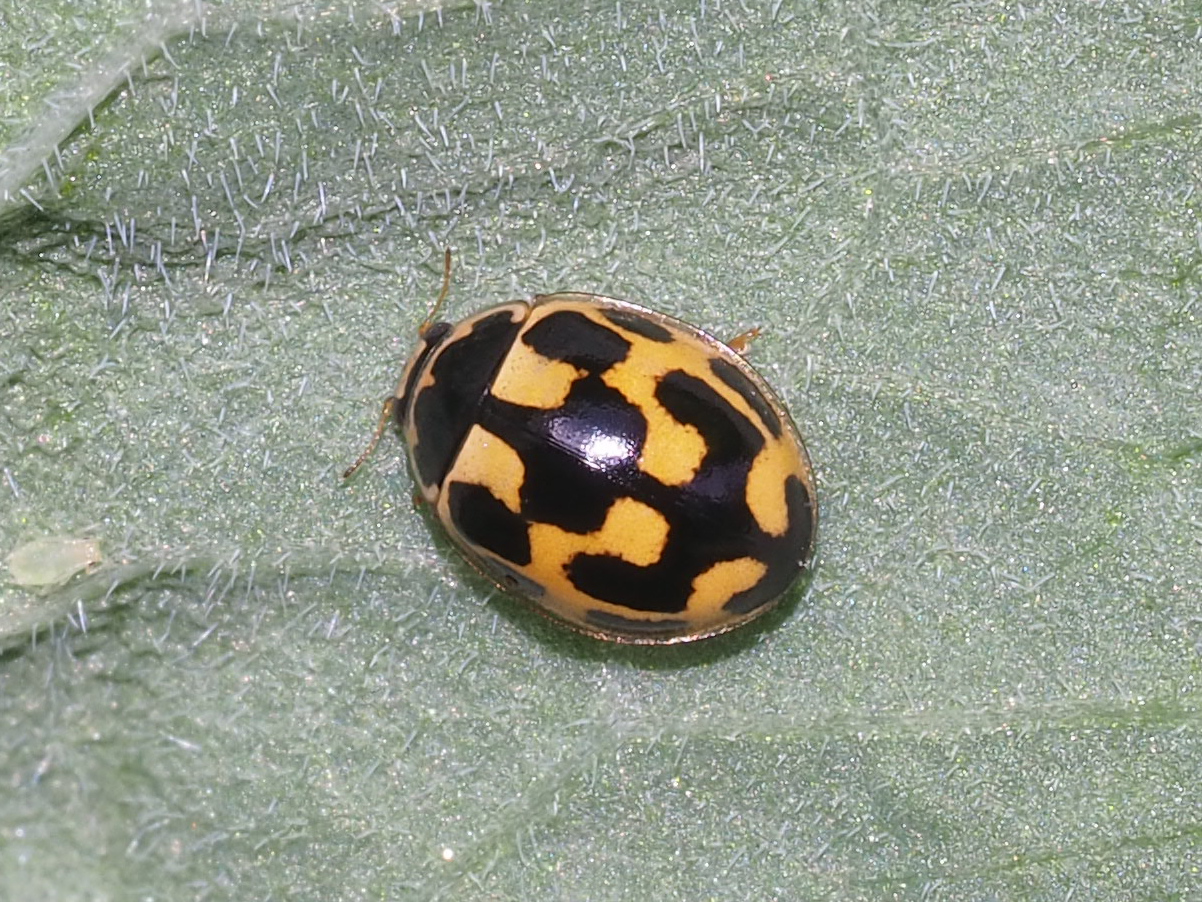
Propylea quattuordecimpunctata 方斑瓢蟲
Common name: Fourteen-spot Ladybird
Scientific name: Propylea quattuordecimpunctata 方斑瓢蟲
Genus: Propylea 龜紋瓢蟲屬
Family: Coccinellidae 瓢蟲科, ladybirds
Suborder: Polyphaga 多食亞目, non-water beetles and weevils 象甲, 象鼻蟲
Order: Coleoptera 鞘翅目, beetles
Remarks: The 14-spot ladybird is bright yellow with up to 14 rectangular black spots on the wing cases; these spots are variable in shape and may become fused to create a chequered 方格的 pattern. It can be distinguished from the smaller, but similar, Psyllobora vigintiduopunctata 廿二點瓢蟲, 22-spot ladybird by its more rectangular, merging spots.
Adults and larvae feed on soft-bodied insects, typically aphids and whiteflies but also mites, caterpillars and insect eggs etc. They occur on a very wide range of broadleaf trees, shrubs and herbaceous plants generally, in fact anywhere that can provide a sufficient prey population. Adults can also feed on pollen and nectar and may be found on a variety of flowers, perhaps more particularly umbels, in warm weather. It has a long hibernation period, emerging as late as May to breed.
Status: Widespread. This is the only species of the genus to occur in the U.K. It is common or abundant throughout England and Wales north to the Scottish borders and including all the islands. In Scotland there are records scattered north to Inverness including a few from the Western Isles. There are records scattered throughout Ireland. The species occurs from lowlands to subalpine regions in a wide range of habitats; forests, arable land, parks, gardens and wasteland etc.
Sunday, 21 April 2024
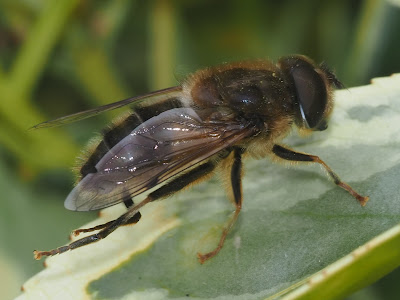
Eristalis pertinax
Common name: Tapered Dronefly
Scientific name: Eristalis pertinax
Genus: Eristalis 管蚜蠅屬
Family: Syrphidae 食蚜蠅科、碧玉蚜蠅科, hover flies, flower flies
Suborder: Brachycera 短角亞目
Order: Diptera 雙翅目, true flies
Remarks: A large Eristalis, easily distinguished from the similar-sized E. tenax and E. simils by the orange coloured front and mid tarsi. E tenax also has entirely dark, swollen hind tibia and stripes of dark hairs on the eyes. Males of pertinax have particularly pointed (tapered) abdomens.
The rat-tailed larvae have been found in farmyard drains and other organically-rich pools, though no doubt use a variety of water bodies including woodland pools and ditches.
Status: E. pertinax is a widespread, often abundant hoverfly that can be found in a wide range of habitats but perhaps especially woodlands and wetlands. It flies from March to November and visits many sorts of flowers. Spring males hover for protracted periods, seemingly defending small territories and can be especially noticeable in woodland rides and gardens in spring. Summer males hover much less frequently.
(43_1) The presence of vena spuria (actually a fold rather than a true vein), the line cuts through the middle of the wing but then peters out, and the false margin, the veins don't extend out to the outer edge of the wing, makes hoverflies different from other flies.
(89_1) Note again the orange coloured front and mid tarsi (blue circle) (vs black front and mid tarsi of E. tenax, common dronefly). Also note the half orange, half black coloured hind tibia (red circle) (vs entirely dark, swollen tibia of E. tenax, common dronefly).
(77) Washing the mid and hind legs?
Friday, 19 April 2024
Bibio marci
Common name: St Mark's Fly
Scientific name: Bibio marci
Genus: Bibio 毛蚋屬
Family: Bibionidae 毛蚋科, St Mark's flies
Suborder: Nematocera 長角亞目
Order: Diptera 雙翅目, true flies
Remarks: The St Mark's fly, or 'hawthorn fly, is a very common, long, shiny, black fly that can be found in large numbers during the spring around woodland edges, fields and wetlands. It is so-called because it emerges around St Mark's Day, April 25th. It hangs in the air over the vegetation, drifting along with its legs dangling underneath it. Large numbers of adults can be found in woodland edges, hedgerows, fields and wetlands.
The larvae live in the soil feeding on roots, grasses and rotting vegetation, and are often found around compost heaps. The adults feed on nectar and are considered to be important pollinators for fruit trees and other plants.
Status: Common
227_1 Note the front tibia 脛節 with a pair of large spurs (vs front tibia with a circlet of small spines in Dilophus)
Wednesday, 17 April 2024
Lilioceris lilii 百合負泥蟲
Common name: Lily Beetle
Scientific name: Lilioceris lilii 百合負泥蟲
Genus: Lilioceris 長頸金花蟲屬
Family: Chrysomelidae 金花蟲科, leaf beetles
Suborder: Polyphaga 多食亞目, mainly non-water beetles, weevils 象鼻蟲
Order: Coleoptera 鞘翅目, beetles
Remarks: Red lily beetle has become the lily growers’ nemesis; the adults and larvae can devour a lily (Lilium 百合屬 and Cardiocrinum 大百合屬 spp.) or fritillary (Fritillaria 貝母屬 spp.) plant in a matter of days. During the past decade it has been consistently one of the top ten pest problems reported to the RHS Members’ Advisory Service. Results from the olfactometer experiments indicate that in the spring female beetles are able to locate lilies by odour alone, and that the beetles preferentially move towards the odour of plants already infested with other beetles.
Status: The lily beetle is not native to the UK. Originally native to parts of Asia the lily beetle has spread gradually since the nineteenth century over most of Europe, North Africa and Asia, this spread being accelerated in recent decades by the international movement of horticultural products.
It was first noticed at the end of the 19th century, with a handful of short-lived infestations. It was not until 1939 that an established colony was discovered in Surrey. By the late 1950s the beetle had become widespread in Surrey and was also found in Berkshire. By 1990 it was found in Hampshire, Middlesex, Wiltshire, Dorset, Hertfordshire and Oxfordshire and by the end of 2005 had been found in almost every English county. In 2002 the beetle was reported from Glasgow and Belfast. Continued reports to the RHS indicate that the beetle is established and spreading in Scotland and Northern Ireland.
Tuesday, 16 April 2024
Chilocorus bipunctata 二星瓢蟲
Common name: Two-spot Ladybird
Scientific name: Adalia bipunctata 二星瓢蟲
Genus: Adalia 大麗瓢蟲屬
Family: Coccinellidae 瓢蟲科, ladybirds
Suborder: Polyphaga 多食亞目, non-water beetles and weevils 象甲, 象鼻蟲
Order: Coleoptera 鞘翅目, beetles
Remarks: Both adult and larvae 2-spot are voracious aphidophages and the adults are very fecund, hence their suitability as biocontrol agents on a wide range of crops worldwide e.g. cotton, peach, potato, beans etc.
Status: It remains locally common through Europe including the U.K. but nonetheless the decline has been drastic in many areas. This decline may be due to competition with the invasive Asian Harmonia axyridis 異色瓢蟲, Harlequin Ladybird, a species known to predate the 2-spot and which has increased alongside the decline of that species.
Sunday, 14 April 2024
Chilocorus renipustulatus
Common name: Kidney-spot Ladybird
Scientific name: Chilocorus renipustulatus
Genus: Chilocorus 唇瓢蟲屬
Family: Coccinellidae 瓢蟲科, ladybirds
Suborder: Polyphaga 多食亞目, non-water beetles and weevils 象甲, 象鼻蟲
Order: Coleoptera 鞘翅目, beetles
Remarks: Both adults are larvae predate a wide range of scale insects on various trees including Oaks, Beech, birches, willows, Alder, maples and various conifers but especially Ash (Fraxinus excelsior L.) and Mountain Ash (Sorbus aucuparia L.).
Status: In the UK it is locally common throughout England and Wales, there are a few scattered records from Scotland but it is so far absent from Ireland. Typical habitats are deciduous woodland and wooded parkland but they also occur on conifers in mixed woodland and may appear on suitable trees in a wide range of habitats through the spring and summer.
Harmonia axyridis 異色瓢蟲
Common name: Harlequin Ladybird
Scientific name: Harmonia axyridis 異色瓢蟲
Genus: Harmonia 和諧瓢蟲屬
Family: Coccinellidae 瓢蟲科, ladybirds
Suborder: Polyphaga 多食亞目, non-water beetles and weevils 象甲, 象鼻蟲
Order: Coleoptera 鞘翅目, beetles
Remarks: It is predatory. It has a preference to feed on aphids but will eat other insects, including scale insects, eggs and larvae of butterflies and moths, other small insects including other ladybirds and it can be cannibalistic. There was a fear that the harlequin ladybird will out-compete some of the native aphid predators and lead to a decline in their numbers. Evidence in Britain so far is mixed with some native ladybirds showing no declines in the presence of the harlequin and others becoming less common; research is on-going. There are no means of controlling harlequin ladybirds, since any actions taken against them would also be harmful to native ladybirds, other aphid predators and other insects.
Status: The harlequin ladybird originates from Japan and has been introduced as a biological control agent around the world to control aphids. It was not deliberately introduced to Britain or Ireland, but it become established in 2004. Since then it has become widespread in England and is spreading in Wales, Scotland and Ireland.
Coccinella septempunctata 七星瓢蟲
Common name: Seven-spot Ladybird
Scientific name: Coccinella septempunctata 七星瓢蟲
Genus: Coccinella 瓢蟲屬
Family: Coccinellidae 瓢蟲科, ladybirds
Suborder: Polyphaga 多食亞目, non-water beetles and weevils 象甲, 象鼻蟲
Order: Coleoptera 鞘翅目, beetles
Remarks*: 7 small to modest-sized black spots on elytra 鞘翅 (vs 7 large spots in Coccinella magnifica, scarce 7-spot ladybird); white marks below forelegs only. (vs small white triangular marks on the underside, below both the middle and front legs in Coccinella magnifica 稀有七星瓢蟲, scarce 7-spot ladybird)
Status: This species was formerly one of the commonest ladybirds throughout Europe from lowlands to mountain areas, including the U.K., but a recent and drastic decline has occurred, in common with several other ladybirds, which is thought to be due to competition from the invasive Asian Harmonia axyridis 異色瓢蟲, Harlequin Ladybird. It occurs throughout the U.K. and remains locally common in many areas, especially in the south, although in nowhere near its former abundance.
175
Wednesday, 10 April 2024
Ballota nigra 寬萼蘇、黑夏至草、黑苦薄荷
Common name: Black Horehound
Scientific name: Ballota nigra 寬萼蘇、黑夏至草、黑苦薄荷
Genus: Ballota 寬萼蘇屬
Family: Lamiaceae or Labiatae 唇形科, mint or deadnettle or sage family
Remarks:
Origin: Archaeophyte (established before 1500 AD). It has a European Southern-temperate distribution. Archaeological evidence suggests that it is an ancient introduction, having been associated with human settlements since the Iron Age.
547_3 Flower bud. Note the brown calyx funnel-shaped, with 5 broad, more or less equal teeth.
547_2 Corolla reddish manuve.
547_1 Flower with 2 lips. The upper one is slightly concave, like a hood, and hairy externally. The lower one is glabrous, with 2 minor lateral lobes and a major central bifid lobe.
-
Common name: Marsh Horsetail Scientific name: Equisetum palustre 犬問荊 Genus: Equisetum 木賊屬 Family: Equisetaceae 木賊科 , horsetail family Or...
-
Common name: Field Horsetail Scientific name: Equisetum arvense 問荊、杉菜 Genus: Equisetum 木賊屬 Family: Equisetaceae 木賊科 , horsetail family O...
-
Common name: Touch-me-not Balsam Scientific name: Impatiens noli-tangere 水金鳳、輝菜花 Genus: Impatiens 鳳仙花屬 Family: Balsaminaceae 鳳仙花科 , bal...